Binational Collaboration Advances with visit and MOU Signing Between GIRAA Auto Cluster and Rio South Texas Region
January 22, 2026
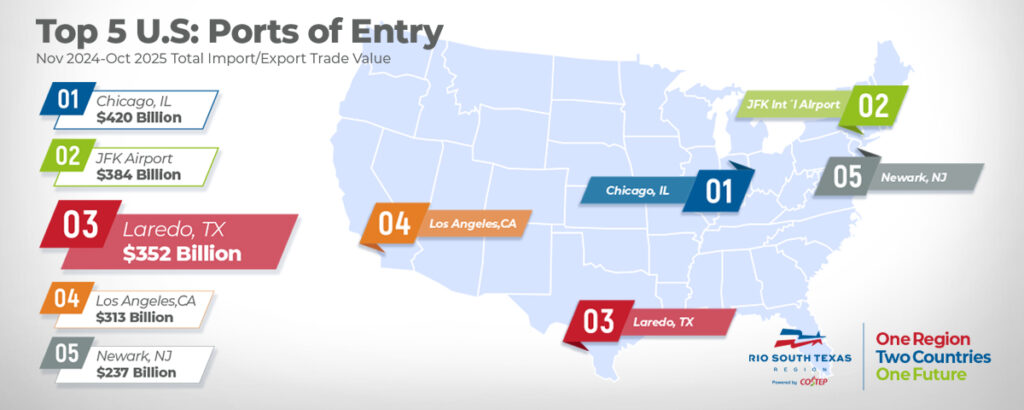
Port Laredo: The 3rd Largest Port of Entry in the United States
January 29, 2026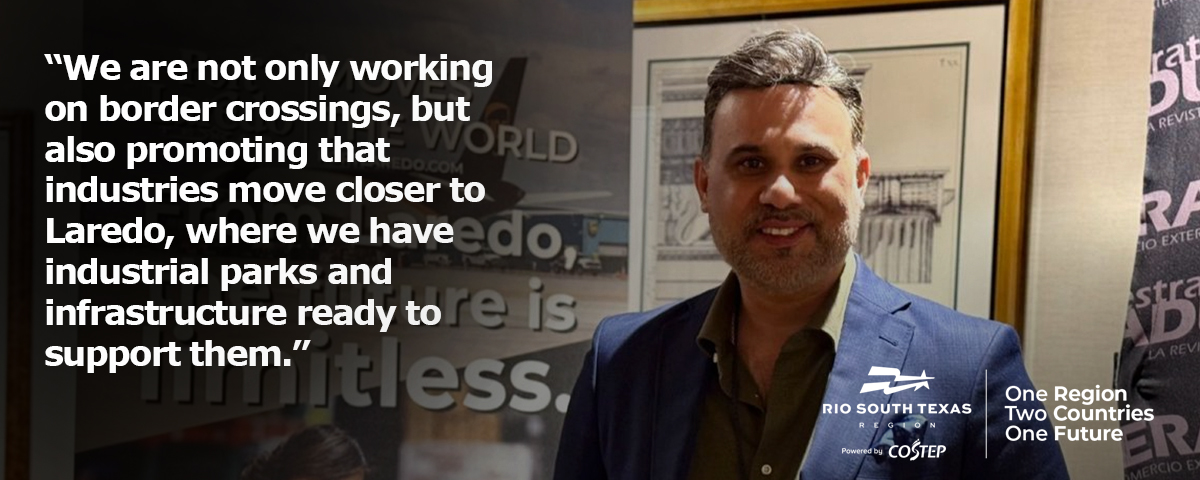
In 2025, Port Laredo consolidated its position as one of North America’s most critical logistics gateways, and as a cornerstone of Rio South Texas Region.
The port handled approximately 35% of total U.S.–Mexico binational trade, averaging 20,000 commercial crossings per day and moving close to $800 billion in annual trade value. These figures confirm not only scale, but resilience, at a time when supply chains across North America continue to be reconfigured.
Speaking at the XII National Congress on Comprehensive Customs Updates, organized by CENCOMEX, Felipe Gabriel Romero, Executive Manager for Marketing and Communications at Port Laredo, emphasized that border operations remain strong despite global trade volatility. According to Romero, the port continues to operate at full capacity, supported by a robust and highly integrated border.
Beyond traffic volume, Port Laredo has expanded its focus toward binational economic development, aligning with nearshoring and smartshoring strategies. The objective is clear: attract industrial operations closer to the border by leveraging existing industrial parks, logistics infrastructure, and cross-border connectivity within the broader Rio South Texas Region.
From a sector perspective, automotive leads trade flows, followed by technology components such as microchips and processors, and heavy machinery, including tractors, vehicles, and tires. At the same time, the port has significantly strengthened its cold chain capabilities, now operating three world-class inspection facilities to support higher volumes of perishable goods and attract Mexican fruit and vegetable exporters.
One of Port Laredo’s most distinctive advantages is its joint inspection model between Mexico and the United States, operating at both the land port and the airport. This binational approach streamlines customs processes and reduces friction, reinforcing the region’s competitiveness as a logistics and manufacturing platform.
Infrastructure investment continues to underpin this growth. The Texas Department of Transportation currently has more than $1.5 billion in active projects dedicated to expanding highways and bridges in the Laredo area, strengthening regional connectivity and throughput capacity.
Smartshoring has emerged as a defining regional strategy. Port Laredo is actively collaborating with key Mexican states: Nuevo León in automotive and automation, Tamaulipas in maquila and healthcare, and Querétaro in aerospace and bilingual talent development. The goal, as Romero stated, is to “manufacture the future from the border.”
Based on preliminary data through October 2025, Port Laredo is expected to rank second or third nationally in total commercial crossings, pending final figures to be released in early 2026.
Looking ahead, the port announced the Global Trade Summit 2026, to be held July 13–14 in Laredo, Texas, conceived not as a traditional conference, but as a strategic working forum focused on compliance, mobility, and competitiveness for companies operating in or entering the U.S. market.
Romero concluded with a message that captures the essence of the region’s success: Port Laredo’s leadership is not defined by geography alone, but by the strength of its relationships with Mexico. Open to companies of all sizes, the port, and the broader Rio South Texas Region, continues to operate as a gateway where trade, industry, and binational collaboration converge.
Partner with Council for South Texas Economic Progress (COSTEP) to evaluate, plan, and execute your expansion into the Rio South Texas Region, one of the most competitive, tariff-free manufacturing and logistics platforms in North America.
From site selection and incentives to workforce, infrastructure, and cross-border strategy, COSTEP works alongside investors at every stage of the decision-making process.