How Serious Capital Makes Financial Decisions at Rio South Texas Region
April 2, 2026
Strengthening the Future of Freight Mobility in Texas
April 10, 2026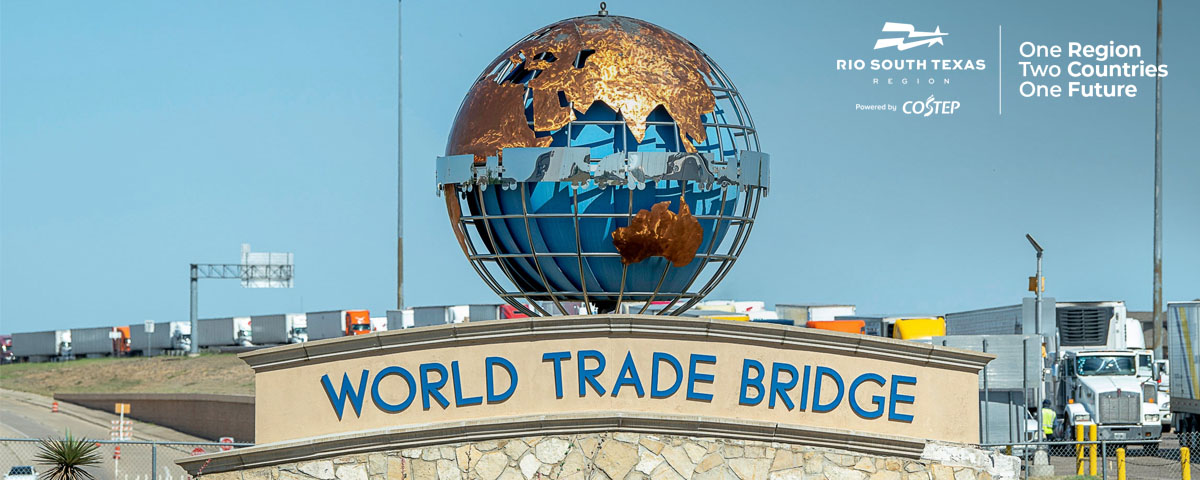
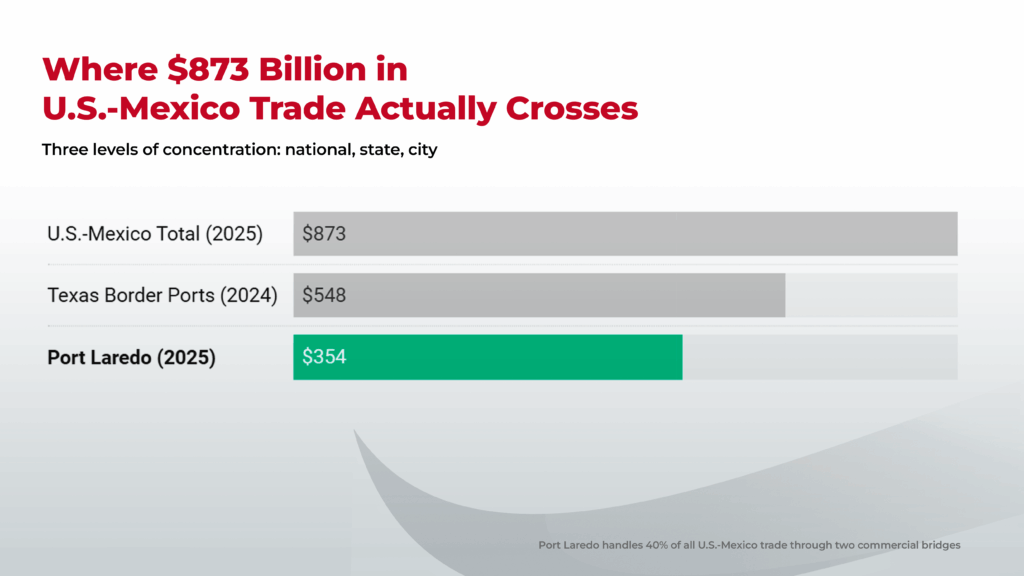
Mexico is now the United States’ #1 trading partner, with a gap that has reached $458 billion. But beyond the macro headlines, the real story is where that trade actually moves.
According to analysis by Daniel Covarrubias in his latest article in The Bridge, nearly $872.8 billion in U.S.-Mexico trade in 2025 is concentrated:
40% of that trade crosses through a single city: Laredo, Texas.
From Global Trade to a 40-Mile Corridor
An $873 billion trade relationship between two nations, representing 470 million people,is funneled through a corridor in South Texas with a population of just 260,000.
At the World Trade Bridge alone:
- 19,800 commercial trucks cross daily
- 6 million trucks annually
- $970 million moves every day
- $40.5 million per hour
- $675,000 per minute
What’s Actually Moving Across the Border
This is not just trade, it is manufacturing in motion.
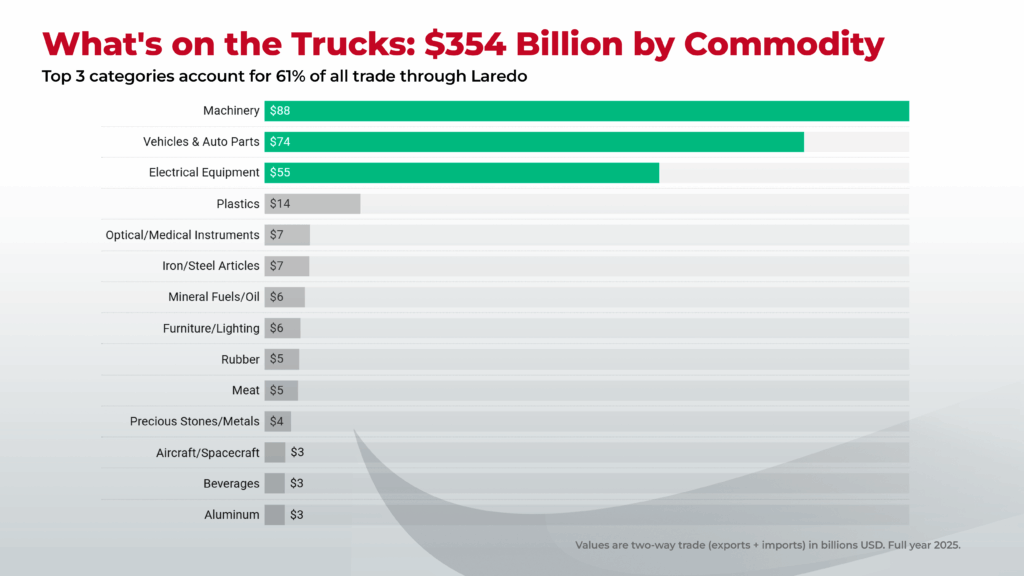
Three sectors dominate cross-border flows:
- Machinery: $88.3B
- Vehicles & auto parts: $74.1B
- Electrical equipment: $54.6B
Together, they represent 61% of all trade. But the key insight is not volume, it’s circulation.
Components don’t cross once. They cross multiple times.
An engine block can:
- Start as U.S. steel
- Be machined in Monterrey
- Return to Texas for testing
- Go back to Mexico for assembly
- Cross again as part of a finished vehicle
Some components cross the border up to 8 times before completion.
This is what a fully integrated North American manufacturing system looks like in real terms.
If Laredo Were a Country
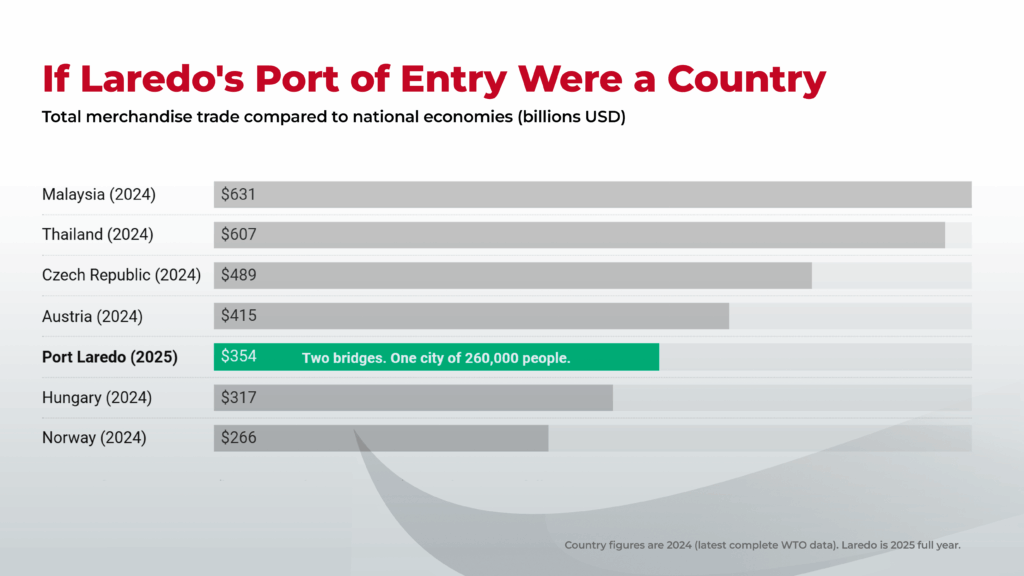
With $353.9 billion in annual trade, the Laredo Port of Entry would rank around #31 in global trade, comparable to countries like Austria or Hungary.
But unlike those nations:
- Laredo has just 260,000 people
- And operates as the most efficient land-based trade corridor in North America
Why This Corridor Works
This level of concentration is not accidental, it is engineered.
Within a 40-mile binational radius, the region integrates:
- 500+ customs brokers
- 500+ freight carriers
- 300+ warehousing facilities
- 30,000+ logistics jobs
- 61 million sq. ft. of industrial space
- Direct connectivity to Monterrey via 140 miles of toll highway
On the Mexico side, Tamaulipas and Nuevo León contributes:
- 1305 IMMEX manufacturing operations
- Nearly 660,000 direct workers
Global companies like KIA, Caterpillar, and General Motors depend on this corridor daily.
A National Supply Chain Backbone
This is not just a regional story.
The Interstate 35, starting at Laredo, extends 1,568 miles to Minnesota, supporting $1.2 trillion in economic activity, nearly 49% of Texas’ GDP.
No land port in the world handles more commercial truck traffic.
Why This Matters Now
Trade policy is debated in Washington.
Trade reality happens in Rio South Texas Region.
Every:
- Tariff adjustment
- Inspection delay
- Rule-of-origin change
…creates ripple effects across North American supply chains.
The upcoming July 2026 USMCA Joint Review will define the future of this system:
- Renewal
- Renegotiation
- Or a path toward sunset
What is at stake is not just trade volume, is the operational backbone of North American manufacturing.
The Strategic Takeaway
This is not just a border. It is not just logistics. It is a high-performance, binational production system operating in real time. And it is already moving close to a billion dollars a day.
Companies don’t need to build this ecosystem. They can plug into it.
Rio South Texas Region offers direct access to one of the most efficient, scalable, and integrated trade corridors in the world.
Explore opportunities to expand your operations where trade actually happens: https://riosouthtexasregion.com/