COSTEP brings the Rio South Texas Region to Munich
November 10, 2026
Port Laredo moved $38.9 billion in trade in September 2026, its biggest month on record. That brought trade over the 12 months through September to $402.7 billion, the first time any 12-month period has cleared $400 billion.
Computer and server imports reached $8.3 billion in September alone, the highest monthly total since at least 2019. Over 12 months, computers, phones, and computer parts accounted for $43.9 billion of the port’s $52.8 billion increase.
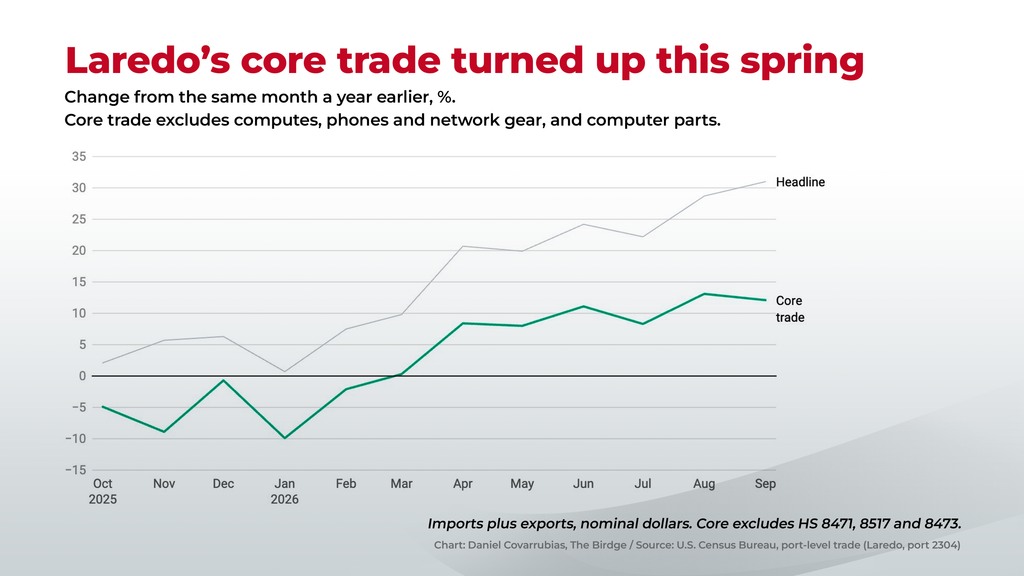
Core trade has been climbing since February.
Laredo’s 12-month core trade total bottomed at $302.7 billion in February, then rose every month for seven months to reach $318.4 billion, up 2.9% year over year. Since April, each month has come in 8% to 13% above the same month a year earlier. From July through September, core trade rose 11.2%, or $8.6 billion.
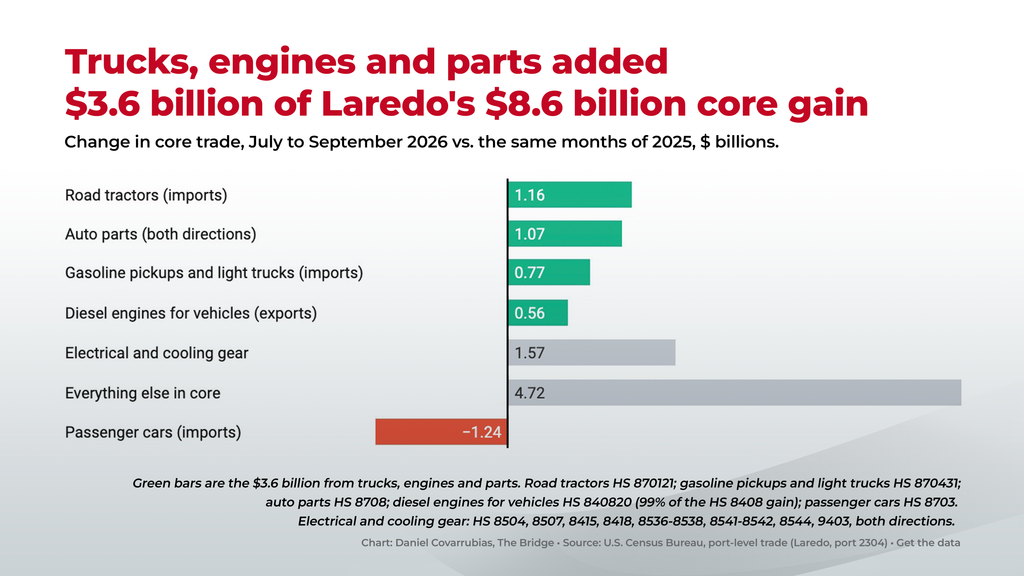
Trucks, engines, and auto parts contributed about $3.6 billion, more than two-fifths of that gain.
Road tractors, the cabs that pull semi-trailers, rose from $970 million in Q3 2025 to $2.12 billion in Q3 2026. A weak quarter a year earlier accounts for part of the rebound. Over 12 months, tractor imports from Mexico were still slightly down.
Gasoline Port Laredo moved $38.9 billion in trade in September 2026, its biggest month on record. That brought trade over the 12 months through September to $402.7 billion, the first time any 12-month period has cleared $400 billion.
Computer and server imports reached $8.3 billion in September alone, the highest monthly total since at least 2019. Over 12 months, computers, phones, and computer parts accounted for $43.9 billion of the port’s $52.8 billion increase.
Core trade has been climbing since February.
Laredo’s 12-month core trade total bottomed at $302.7 billion in February, then rose every month for seven months to reach $318.4 billion, up 2.9% year over year. Since April, each month has come in 8% to 13% above the same month a year earlier. From July through September, core trade rose 11.2%, or $8.6 billion.
Trucks, engines, and auto parts contributed about $3.6 billion, more than two-fifths of that gain.
- pickups and other light trucks rose from $800 million to $1.56 billion.
- Auto parts added $1.1 billion across both directions, and southbound diesel engines added $600 million.
- Passenger cars fell by $1.2 billion.
The quarter’s gains in vehicle trade came from tractors and pickups heading north, engines heading south, and parts moving both ways. The trade records show what crossed the border. The reason tractor imports doubled remains open.
Up to $1.6 billion of the core trade gain came from switchgear, cable, batteries, cooling units, and similar equipment that data centers also buy. Those products are included in core trade because the records identify the goods and leave the end buyers unknown. Excluding all of them would still leave core trade up about 9% for the quarter.
The national figures put Laredo’s quarter in perspective.
U.S. imports from Mexico reached $616.8 billion over the 12 months through September, up 17.4%. Core imports reached $435.3 billion, up 0.5% after falling 0.6% in the 12 months through August.
Nationwide, U.S. imports of cars, trucks, and auto parts from Mexico were still down $6 billion over 12 months, and car imports fell another 15% in the third quarter.
The trucks tell their own story.
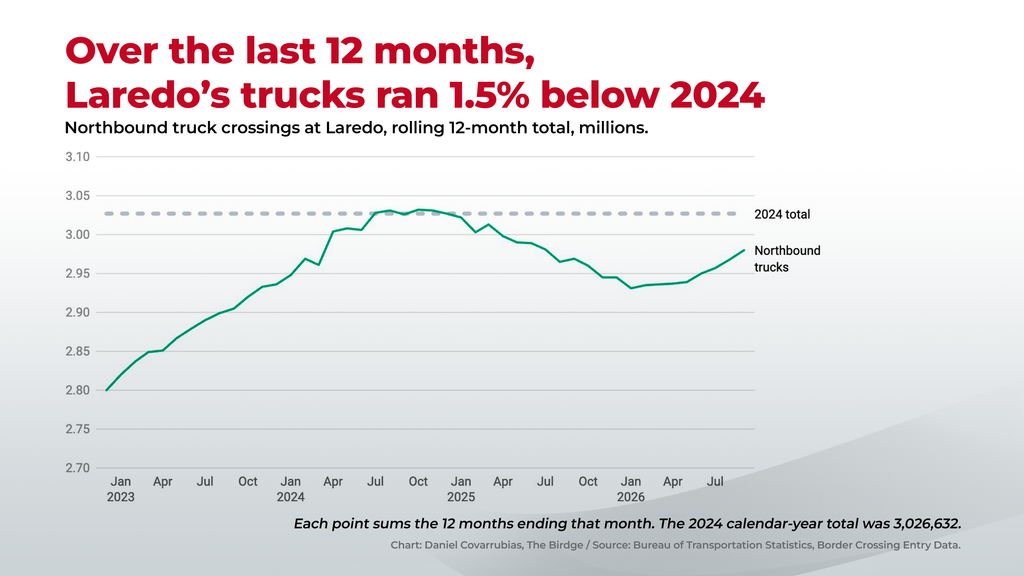
Laredo’s northbound truck crossings exceeded year-earlier levels for four straight months, rising 4.7% in June, 2.5% in July, 4.6% in August, and 4.9% in September. For the third quarter, crossings were up 4.0%, a little over a third of the pace of core trade growth. Total trade rose 27% over the same quarter.
Over the past year, truck crossings have tracked core trade more closely than total trade. September put that pattern to the test as the gap between the two trade measures widened. Servers and electrical equipment cross by truck too, and the electrical equipment is already counted in core trade. A trailer of servers can carry far more value than a trailer of tractors or brake parts, which likely explains why data-center demand adds trade dollars much faster than truck crossings.
How close is Laredo to a new truck record?
- 2024: 3,026,632 northbound truck crossings, the record.
- 2025: 2,945,388 crossings, down 2.7% and the first annual decline since 2020.
- October 2025 through September 2026: 2,980,096 crossings, about 8,165 per day and 1.5% below the 2024 record.
After a flat first half, crossings were up 1.6% for calendar 2026 through September. If fourth-quarter crossings grow 4% year over year, Laredo would end 2026 near 3.01 million. Fourth-quarter growth would have to reach almost 7% to break the 2024 record this year.
If crossings continue growing 4% annually, Laredo could reach about 3.1 million in 2027, setting a new record. That projection rests on one strong quarter. The figures already on the books show four straight months of year-over-year growth in northbound truck crossings and core trade running at least 8% ahead of year-earlier levels each month since April.
As long as data-center budgets keep growing, servers will likely continue to drive the dollar value of trade. Watch the truck count for how the rest of the corridor is moving.
Rio South Texas Region. One Region. Two Countries. One Future.
This post draws on trade analysis published in The Bridge, Daniel Covarrubias’s newsletter. Read the original article, “Laredo Passed $400 Billion. Follow the Trucks.”