Rio South Texas Region Reaffirms Itself as a Strategic U.S. Expansion Platform Before INDEX Nacional
February 24, 2026
Foreign Trade Zones: Rio South Texas Region’s Built-In Tariff Mitigation Strategy
March 2, 2026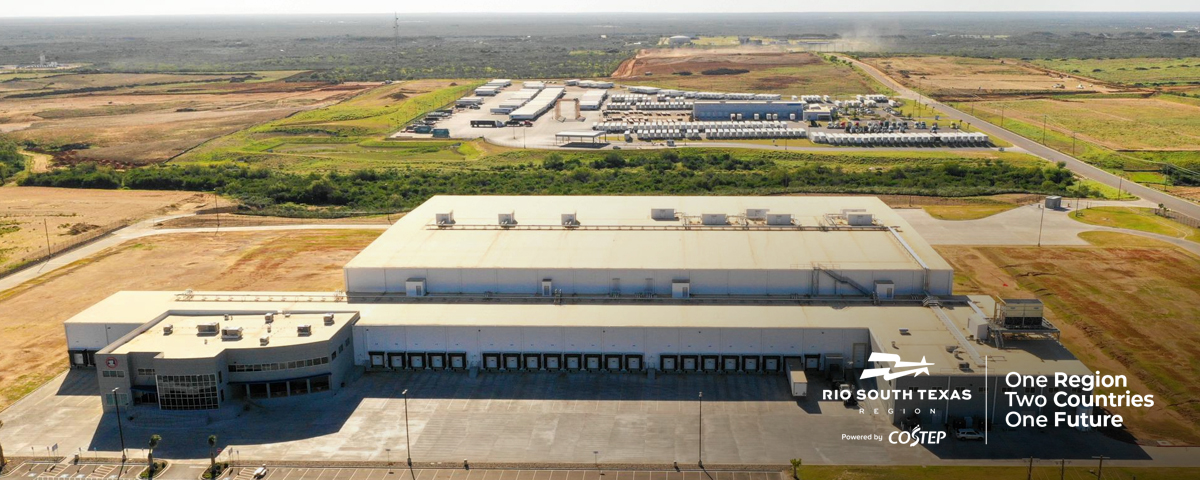
Based on “OpEd 53 Building on Trade” analysis by Dr. Daniel Covarrubias, Director of the Texas Center for Border Economic and Enterprise Development at Texas A&M International University.
For decades, capital flowed through the U.S.–Mexico border.
Goods crossed. Trucks moved. Warehouses turned inventory.
But increasingly, something different is happening.
The money is staying.
Laredo, Texas is no longer simply where trade passes. It is where value is being anchored.
The Numbers Signal Structural Change
Trade through the corridor continues to expand at historic levels. In 2024 alone, more than $339 billion moved through the Port of Laredo, exceeding $350 billion in 2025.
At the same time, the industrial footprint has expanded dramatically. The market is projected to reach 61 million square feet by the end of 2026, supported by a construction pipeline that has grown 247% since mid-2024 .
Investment across new industrial corridors now comfortably exceeds $1 billion in land, infrastructure, and vertical construction .
And this growth is not abstract. It is reflected in the tax base. The City of Laredo’s property tax levy increased from $67.6 million in 2013 to over $137 million by 2025, accelerated by industrial construction that began in 2020 .
These are not transit metrics.
These are permanence metrics.
What Changed?
This transformation did not happen by accident.
Three structural shifts aligned:
- Mexico became the top exporter to the United States.
- Nearshoring moved from discussion panels to corporate boardrooms.
- Institutional capital entered the corridor at scale.
Developers responded with fully urbanized industrial land, Class A facilities exceeding 300,000 and 400,000 square feet, and multi-phase logistics parks designed to meet national and global tenant standards .
National investment firms managing billions in assets began deploying capital in the region.
When market conditions, trade momentum, and private capital align simultaneously, corridors evolve.
Rio South Texas Region is experiencing that evolution now.
From Gateway to Gateway-Plus
Historically, freight entered the United States through this corridor and moved north for distribution.
Today, the infrastructure exists to rethink that model.
With nearly 20,000 commercial truck crossings daily and 40% of all U.S.–Mexico trade flowing through this single corridor , the economic case for co-locating distribution at the point of entry has never been stronger.
This is the shift from:
Gateway → Gateway + Distribution Hub → Capital Platform
The building stock now supports it.
The lot sizes support it.
The institutional tenant base supports it.
The region is positioned not just to process freight, but to capture value.
Why This Matters for Investors and Site Selectors
Institutional capital does not move for cycles. It moves for structure.
What is taking shape in Rio South Texas Region is not a temporary construction wave. It is the formation of a durable logistics ecosystem:
- Class A industrial inventory
- Large-scale fully serviced land
- Institutional joint ventures
- Private family office acquisitions
- Multimodal connectivity
- Workforce depth connected to Mexico’s industrial spine
This corridor sits at the northern end of Mexico’s manufacturing backbone, connecting Monterrey, Saltillo, the Bajío region, Mexico City, and Pacific ports directly into U.S. commerce.
Few trade corridors in North America combine scale, geography, and capital alignment at this level.
The Strategic Opportunity Ahead
Real estate markets normalize. Vacancy adjusts. Supply balances.
But trade fundamentals remain intact.
The next competitive layer will be built on:
- Workforce development
- Multimodal infrastructure integration
- Streamlined permitting
- Coordinated regional planning
The private sector has built the foundation.
Now the opportunity is regional.
The Bigger Picture
For decades, Rio South Texas Region was defined by throughput.
Today, it is being defined by retained capital, institutional investment, and structural expansion of its tax and industrial base.
Trade built the corridor.
Investment is building permanence.
Laredo and Rio South Texas Region are not just where goods cross.
Value settles there.
This is the moment to explore investment and expansion opportunities in Rio South Texas Region by the hand of COSTEP, Council for South Texas Economic Progress.