Greater Brownsville Tech District: From Manufacturing to Mindfacturing
January 5, 2026
McAllen–Reynosa: A Binational Platform Built for Industrial Continuity
January 9, 2026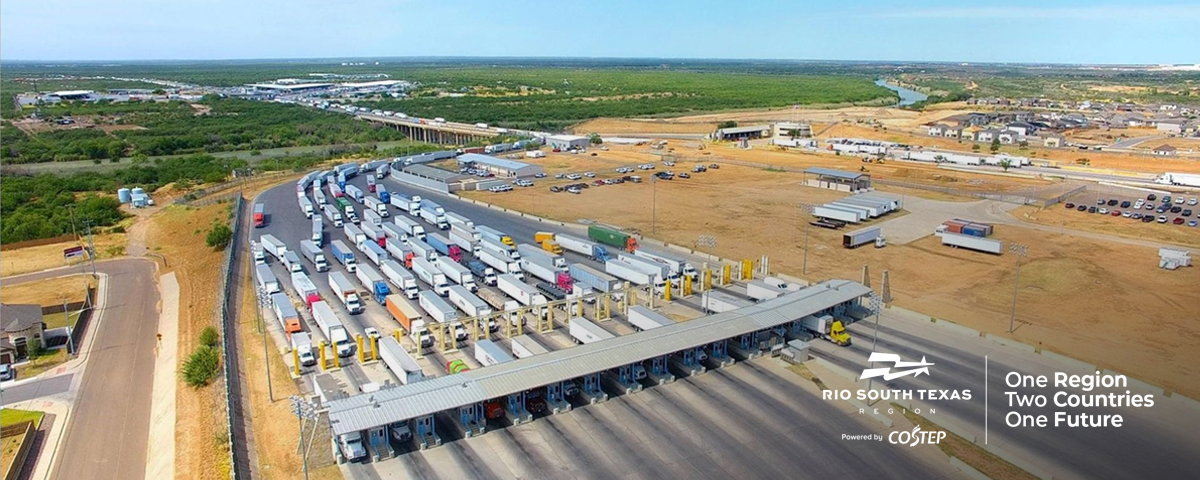
In today’s global environment, companies are no longer choosing locations based solely on incentives or proximity. They are choosing systems—ecosystems that reduce risk, sustain production, and perform reliably under pressure.
That is precisely where Port Laredo stands apart.
Far from being a traditional border crossing, Port Laredo has consolidated its position as one of the most critical trade corridors in the United States, functioning as a strategic engine for U.S. manufacturing, logistics, and economic resilience.
Scale that proves performance
Year to date, trade through Port Laredo has surpassed $265 billion, ranking it third among all U.S. ports and first among land ports of entry. Growth has been equally telling: more than 80% expansion over the past five years and nearly 78% over the last decade—not a spike, but sustained momentum.
By September 2025 alone, the port recorded $29.6 billion in trade, with imports exceeding $19 billion and exports reaching $10.5 billion. This balance reflects a mature corridor that simultaneously supports U.S. manufacturing, assembly operations, and consumer markets.
High-value industries already depend on it
What moves through Port Laredo explains why it matters.
On the export side, motor vehicle parts, refined fuels, and aerospace components dominate—core inputs for advanced manufacturing, energy, and aviation supply chains. Imports tell an equally strategic story, led by computers, automotive components, and passenger vehicles that feed U.S. technology ecosystems and automotive production networks.
These industries do not tolerate friction. They require speed, reliability, and scale—and Port Laredo consistently delivers all three.
Built to adapt, not just to grow
Beyond volume, Port Laredo has demonstrated an ability to absorb shifting trade dynamics. Rising flows of computer parts, specialized machinery, pharmaceuticals, precious metals, and high-tech goods signal deeper integration with technology-driven and life-sciences supply chains.
For site selectors, this translates into something critical: long-term relevance. The corridor is not optimized for yesterday’s trade—it is structured for what comes next.
A binational corridor with national impact
Nearly 97% of the trade moving through Port Laredo is tied to Mexico. This is not concentration risk—it is evidence of deep industrial integration. Manufacturing processes on both sides of the border are increasingly interdependent, and Port Laredo serves as the operational backbone of that relationship.
At the same time, trade flows with global partners such as France, China, Chile, and Japan reinforce the port’s role within broader international supply chains. In several categories—motor vehicle parts, diesel engines, electric batteries, and air-conditioning equipment—Port Laredo handles a significant share of total U.S. trade.
Why this matters for location decisions
As nearshoring reshapes North American manufacturing, companies are prioritizing locations that offer resilience, efficiency, and scalability. Laredo and the broader Rio South Texas Region sit at the center of this equation.
Locating operations here means direct access to one of the most reliable trade corridors in the country, proximity to integrated binational supply chains, competitive operating costs, and room to scale without the congestion faced by legacy hubs.
Port Laredo is no longer just a gateway.
It is an operating system for North American industry—and a strategic asset for companies planning their next phase of growth.
Rio South Texas Region: One Region, Two Countries, One Future.