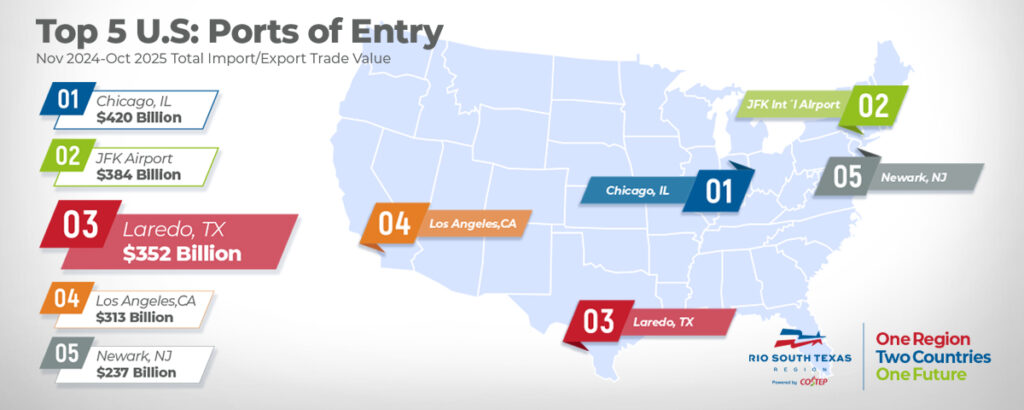
Port Laredo: The 3rd Largest Port of Entry in the United States
January 29, 2026
Texas Leads U.S. Job Growth Thanks to a Business-Driven Investment Environment
February 4, 2026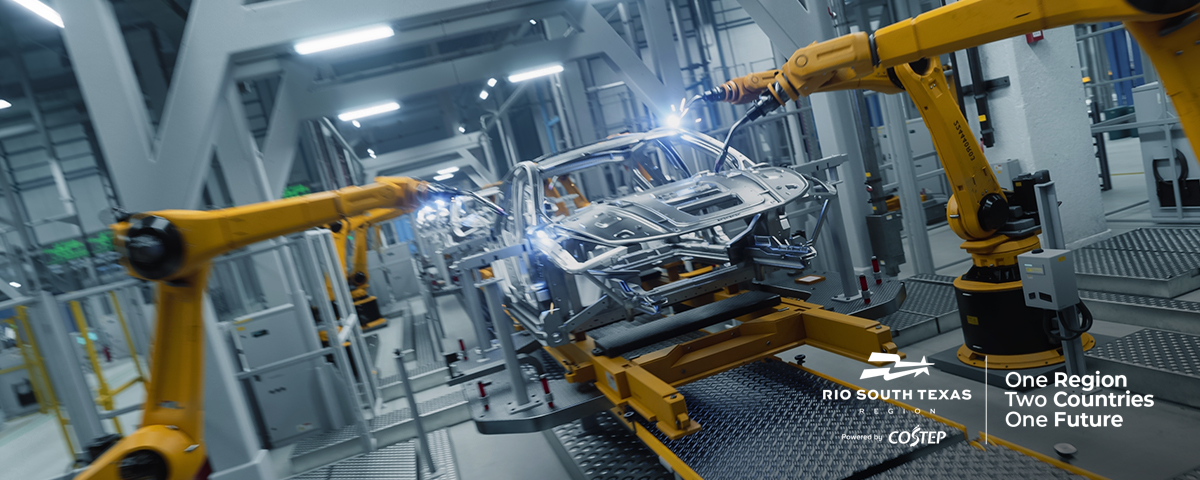
As global trade dynamics continue to shift, the automotive industry finds itself at the center of geopolitical and economic recalibration. Tariff exposure, evolving USMCA rules of origin, supply chain disruptions, and rising pressure for operational certainty inside the United States are reshaping where and how automotive companies invest.
In this context, the Rio South Texas Region is emerging as a strategic platform, not simply for logistics, but for long-term financial and operational resilience.
A Binational Manufacturing Advantage
One of the region’s strongest differentiators is its ability to support binational operating models:
- Mexico for labor-intensive processes
- South Texas for final assembly, validation, testing, and distribution
This structure allows companies to maintain cost efficiency while gaining regulatory certainty and tariff protection within the United States.
Competitive Cost Structure Inside the U.S.
Compared to traditional automotive hubs, South Texas offers:
- Lower labor costs
- Competitive industrial land and facility pricing
- Pro-business state and local incentive programs
Texas provides the regulatory stability companies need; South Texas delivers that stability at a more competitive cost.
Tariff Mitigation Through U.S.-Based Assembly
Automotive manufacturing is one of the most tariff-sensitive industries in North America. Establishing assembly, sub-assembly, or final processing operations in South Texas allows companies to classify vehicles and components as U.S.-made or U.S.-assembled, significantly reducing or eliminating tariff exposure.
By relocating the final stages of production, OEMs and suppliers can:
- Stabilize pricing structures
- Protect margins amid policy volatility
- Improve compliance with USMCA content requirements
In many cases, relocating the last 15–20% of the process delivers the majority of the financial benefit.
A Natural Platform for OEMs, Tier 1, and Tier 2 Suppliers
The Rio South Texas Region is ideally positioned to support:
- Tier 1 suppliers producing modules, interiors, wiring systems, and electronic components
- Tier 2 suppliers focused on metal stamping, plastics, machining, and subcomponents
- OEMs seeking final assembly, vehicle configuration, or U.S. distribution hubs
Rather than displacing existing operations, the region complements Mexico-based manufacturing by strengthening the final link to the U.S. market.
Reduced Logistics Costs and Just-in-Time Efficiency
Proximity to U.S. automotive markets enables:
- Shorter transit times
- Lower inventory-in-transit costs
- Greater reliability for Just-in-Time and Just-in-Sequence models
For automotive supply chains, speed and predictability are no longer advantages, they are requirements.
Strategic Recommendations for Automotive Companies
To fully capture the region’s advantages, automotive firms should:
- Focus on process placement, not full relocation
- Evaluate Foreign Trade Zones (FTZs) and incentive structures early
- Design fiscal, logistics, and compliance strategies from day one
- Enter with a phased growth model aligned with OEM demand
Done correctly, these decisions transform nearshoring from a tactical move into a structural advantage.
A Region Built for Automotive Resilience
In today’s environment, the Rio South Texas Region stands as a strategic extension of North America’s automotive ecosystem, one designed to help manufacturers and suppliers navigate tariffs, comply with USMCA, protect margins, and deliver with certainty to the U.S. market.
Partner with Council for South Texas Economic Progress (COSTEP) to evaluate, plan, and execute your expansion into the Rio South Texas Region, one of the most competitive, tariff-free manufacturing and logistics platforms in North America.
From site selection and incentives to workforce, infrastructure, and cross-border strategy, COSTEP works alongside investors at every stage of the decision-making process.